
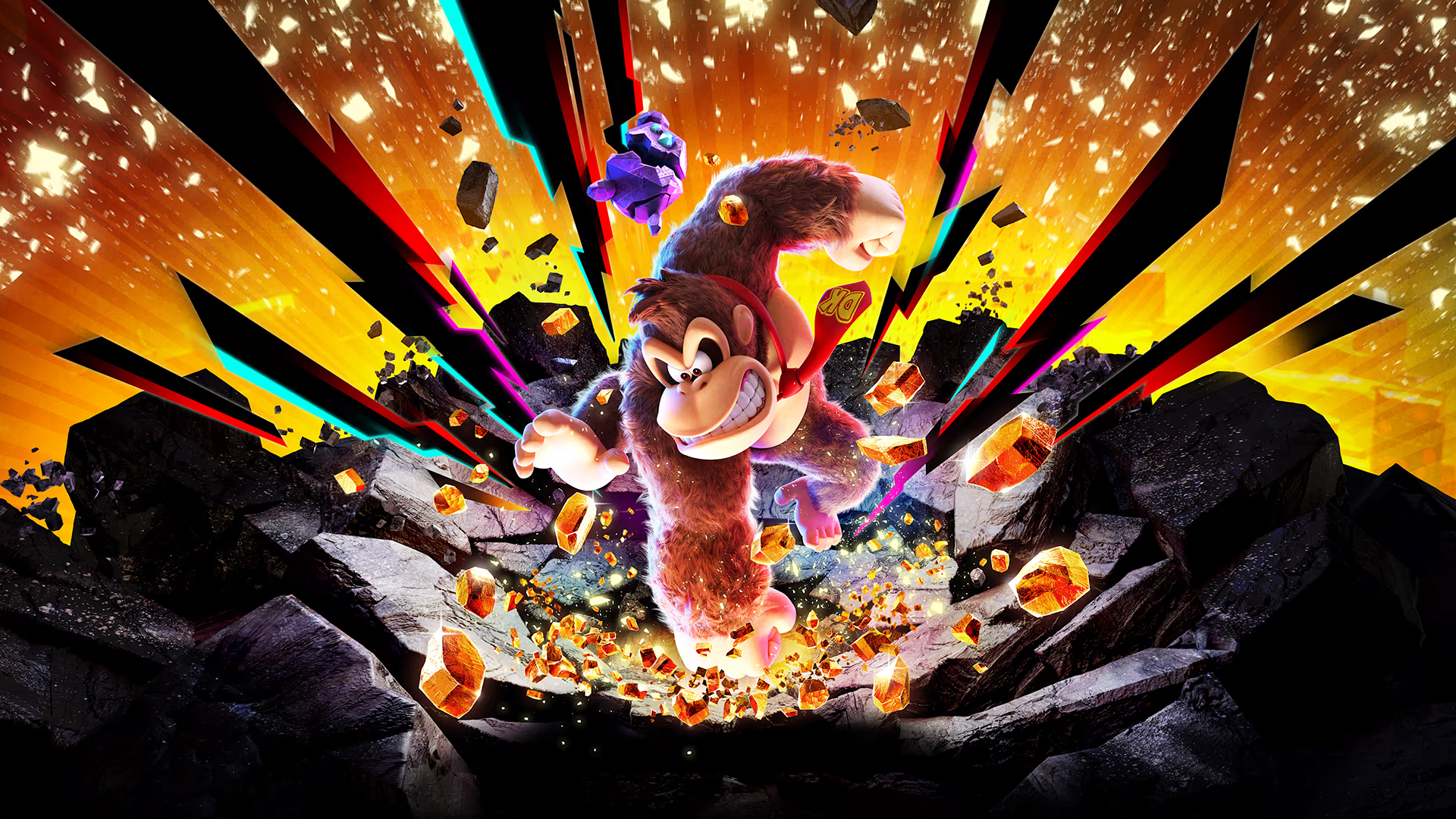
Donkey Kong Bananza
The Super Mario Odyssey team's first Switch 2 platformer. Voxel destruction is real, Pauline rides on DK's shoulder, and the no-cloud-save disclaimer that briefly haunted pre-launch coverage was dropped before release.
The first thing to know about Donkey Kong Bananza is the team that built it. This is Nintendo EPD Tokyo, the studio behind Super Mario Odyssey, returning to a 3D action-platformer eight years later with a new lead character and a new central mechanic. Voxel destruction. The terrain breaks apart under DK’s fists in chunks, not in scripted set pieces, and the game’s hub-and-spoke level structure is built around the fact that you can punch through most of the geometry you see.
The honest catch worth knowing if you read pre-launch coverage: Nintendo’s April 2025 product pages briefly listed no cloud save support. That disclaimer was removed before the July launch and the game does support Nintendo Switch Online Save Data Cloud as standard. If you saw the early “no cloud save” framing in launch-window previews, that is no longer accurate.
Game overview
Donkey Kong Bananza is a 3D action-platformer set across discrete named regions — Ingot Isle, Lagoon Layer, and the rest of a hub-and-spoke world that is closer to Super Mario Galaxy than to Mario Kart World. It is not open-world. You travel between locations rather than driving a continuous map.
The voxel-destruction mechanic is the game’s gameplay differentiator. Most of the terrain you see is breakable, in chunks that respond to fist impact and let you tunnel through walls, dig downward through floors, or carve shortcuts that the level designer did not strictly intend. Power-ups give DK five transformation forms: Kong, Zebra, Ostrich, Elephant, and Snake. Each changes traversal in a different way, from raw strength and ground speed to a glide window, terrain-swallowing throws, and a spring-loaded high jump.
The co-op partner is Pauline. Yes, the same Pauline from Super Mario Odyssey, here as a thirteen-year-old companion who rides on DK’s shoulder and provides vocal blasts that clear small enemies and trigger DK’s transformations. Player two controls Pauline with a single controller; player one controls DK. There is no split-screen because there does not need to be one: both players are looking at the same camera, and the two roles use different inputs on different pads. Genuinely playable on a single handheld.
Where you can play it
Switch 2, and Switch 2 only.
Bananza shipped on 17 July 2025, six weeks after Switch 2 launched, which means it is not a launch-day title even though launch-window coverage often treats it as one. The original Switch cannot run it natively; the voxel destruction system was built for Switch 2’s increased memory bandwidth.
Performance in TV mode is dynamic resolution between 1080p and 1200p at a 60 fps target, with HDR. Handheld runs at a steadier ~1080p and, by Digital Foundry’s read, holds up better than docked. The upscaler is AMD FSR 1, an older path than the DLSS Nintendo uses on some other first-party Switch 2 titles; image quality is clean in motion but static screenshots show softer edges than DLSS-upscaled stablemates. The 60 fps is a target, not a lock: DF documents v-sync dropping the game to 30 fps when it cannot hold 60 in the heaviest voxel-destruction scenes, including one boss fight that sits at 30. You notice it in the moment, then it recovers.
No PC, no PlayStation, no Xbox. Nintendo first-party policy holds.
The post-launch DLC story is worth a flag for catalogue-page completeness. DK Island & Emerald Rush is the paid expansion, released 12 September 2025 at $19.99. At the 9 June 2026 Nintendo Direct, Nintendo announced a free Super Mario crossover that rolls out in four time-limited waves through summer 2026, putting Mario and Luigi outfits onto DK and Pauline and adding Brick Blocks and Super Mushrooms to Emerald Rush. One catch: the crossover is free but it requires owning the DK Island & Emerald Rush DLC, so it is not a reason for base-game-only players to come back. Separately, a DK Challenge event runs via Nintendo Switch Online through 1 September 2026, with collectible Challenge Cards earned across the DK Nintendo Classics titles and Bananza.
Cross-saves and keeping your progress
Bananza supports Nintendo Switch Online Save Data Cloud. The game ships with three save slots per user, auto-save at checkpoints, and manual save. If you upgrade to a new Switch 2 console, NSO cloud restore or the system-transfer wizard moves your save over.
There is no cross-platform sync because there is no other platform to sync to. Bananza is Switch 2 exclusive and is likely to stay that way.
One Switch 2 feature worth a flag: GameShare. The system lets you share the co-op with a nearby player who does not own the title, because the host streams the running game. For local GameShare that guest can even be on an original Switch, not only a Switch 2: the streaming is what makes Bananza playable on hardware that cannot run it natively. Online GameShare goes over GameChat and is Switch 2 to Switch 2 only. Either way, any progress the guest makes is session-only, so if they buy their own copy later they start from zero, and the host’s save is unaffected. Worth knowing before you invite a friend over for a long co-op session.
Features that matter on the move
- Two-player co-op in handheld works on a single Switch 2 with a Joy-Con 2 split. The shoulder-rider format does not require split-screen, which means handheld co-op is genuinely playable — both players see the same camera.
- Remote play is GameShare, not online co-op: there is no native online co-op netplay. A remote player can join as Pauline only via GameShare over GameChat, where the host streams the running game (Switch 2 to Switch 2, NSO required). Handy when one of you is travelling, but it is host-streamed, not each player on their own copy.
- Suspend-resume is reliable in handheld and tabletop modes across the post-launch reporting period. No documented save-loss issues from sleep cycles.
- Battery drain runs on the heavier side for a Switch 2 title, given the voxel physics doing real work each frame. Plan for shorter portable sessions or a power bank if you are travelling.
- Three save slots means a household can run parallel parent-and-kid playthroughs without overwriting each other.
Recommended setup
Joy-Con 2 controllers handle Bananza fine for single-player. For co-op, two pads are easier than the Joy-Con split. The 8BitDo Pro 2 pairs with Switch 2 and adds proper triggers and a sturdier grip than the Joy-Con if you are doing long sessions on the couch.
If you also play on PC or Switch 1, the Pro 2 is the cleanest cross-device pad. For Switch-2-only households, the official Pro Controller works.
See our controllers guide for the full multi-device pad recommendations, the cross-saves guide for how NSO Save Data Cloud compares with Steam Cloud and PSN, and the Steam Deck vs Switch 2 cornerstone for where Bananza-style first-party Nintendo exclusives sit in the platform-choice question.
Verdict
Donkey Kong Bananza is the first 3D platformer from the Super Mario Odyssey team in eight years and it earns the pedigree. Voxel destruction is a real mechanic, not a marketing line, and the hub-and-spoke world is built to reward the punching-through-walls approach. Pauline as the shoulder-rider co-op partner is a control split that works for households who want two-player handheld without split-screen compromise. The honest editorial flag for buyers: the 60 fps is a target that drops to 30 in the heaviest scenes, and “online co-op” here means GameShare streaming rather than each player on their own copy. Both are easy to miss in launch-window coverage. Worth playing on Switch 2 if you want a single-player platformer that respects your time, and worth playing co-op if you have a kid who wants to be Pauline.
Platform comparison at a glance
| Platform | Available | Key perks / differences |
|---|---|---|
| PC | No | — |
| Xbox | No | — |
| PlayStation | No | — |
| Switch | Yes | Switch 2 exclusive; released 17 July 2025 (six weeks after Switch 2 launch), Developed by Nintendo EPD Tokyo, the Super Mario Odyssey team, Dynamic 1080p-1200p docked, steadier ~1080p handheld; 60 fps is a target not a lock, with v-sync drops to 30 fps in the heaviest voxel scenes, HDR supported, AMD FSR 1 upscaler, not DLSS, which is unusual for the Switch 2 line-up, Two-player local co-op (P1 controls DK, P2 controls Pauline as a vocal sidekick), No native online co-op. A remote player joins only via GameShare over GameChat, where the host streams the running game (Switch 2 to Switch 2, NSO required), Local GameShare lets a nearby player join even on an original Switch (the host streams the game); guest progress is session-only, Paid DLC: DK Island & Emerald Rush, released 12 September 2025 at $19.99. A free Super Mario crossover (Mario and Luigi outfits for DK and Pauline, Brick Blocks and Super Mushrooms in Emerald Rush) rolls out in four time-limited waves through summer 2026 for owners of that DLC, announced at the 9 June 2026 Nintendo Direct. A separate DK Challenge event runs via Nintendo Switch Online through 1 September 2026, earning collectible Challenge Cards across the DK Nintendo Classics titles and Bananza |
| Mobile | No | — |
Cross-save & travel progress
- Nintendo Switch Online Save Data Cloud supported. Three save slots per user. Auto-save at checkpoints plus manual save.
- Switch 2 exclusive. No cross-platform sync to PC, the original Switch, or anything else.
- Pre-launch product pages in April 2025 carried a 'no cloud save support' disclaimer. Nintendo removed that disclaimer ahead of the July launch and cloud save shipped as standard. Worth knowing if you read early coverage.
- Local GameShare lets a nearby player join without their own purchase, and the guest can be on an original Switch as well as a Switch 2 because the host streams the running game. Online GameShare goes over GameChat and is Switch 2 to Switch 2 only. Either way the guest's progress is session-only: if they later buy their own copy they start from zero.
Features & inputs
- Local co-op: Yes
- Online co-op (native): No
- Online workaround: GameShare over GameChat: the host streams the running game to a remote guest who joins as Pauline (Switch 2 to Switch 2, NSO required)
- Controller recommended: Yes
Recommended hardware
Notes
- Frame rate is a 60 fps target, not a lock. Digital Foundry's coverage notes v-sync drops the game to 30 fps when it cannot hold 60 in the heaviest voxel-destruction scenes (one boss fight sits at 30 fps); handheld holds up better than docked.
- FSR 1 is an older upscaler than the DLSS path Nintendo uses on some Switch 2 first-party titles. Image quality is clean in motion; static comparisons show softer edges than DLSS-upscaled stablemates.
- Three save slots is generous for a single-player platformer and matters for households where a kid and a parent both want their own DK run.
- No PvP. The only multiplayer is the co-op shoulder-rider format.